
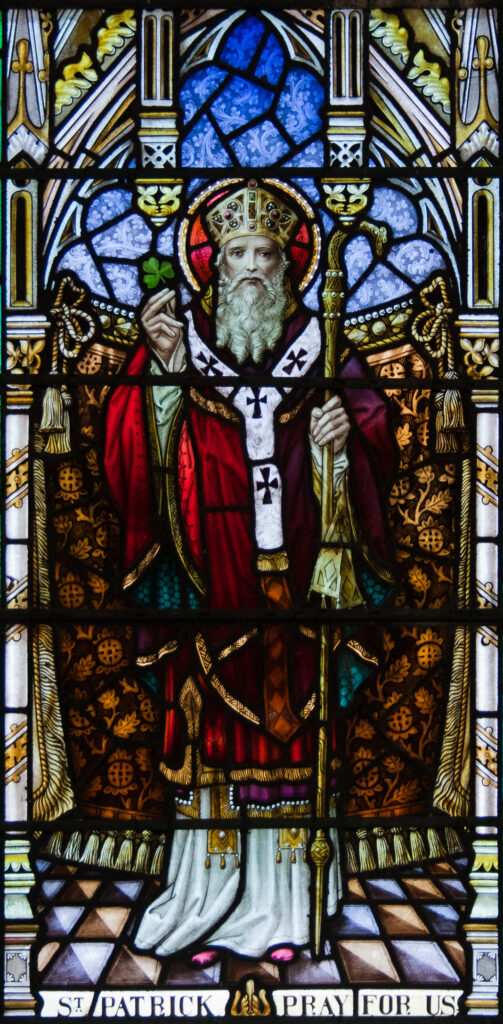
This stained glass window is in the Church of Our Lady, Star of the Sea, in the fourth window of the north wall, located in Goleen, County Cork, Ireland. It depicts Saint Patrick the patron saint of Ireland, whom we remember today. The year of his birth is not known, but he was born in Great Britain to a Roman family, probably in the late 5th or early 6th century, A.D.
And as the story goes, at the age of 16, he was kidnapped by Irish pirates or raiders, taken to Ireland and sold into slavery. He worked there six years as a shepherd, relaying on his faith to see him through those dark days. After returning to Britain, the Irish people were constantly in his thoughts. So much so, that he dreamed they were calling him back to them. Patrick returned and traveled extensively throughout Ireland evangelizing, converting and baptizing the people there.
It is said that Patrick had great respect for non-Christians which possibly enabled him to convert so many to the faith. In artwork, he is easy to identify, as he is almost always shown holding a sprig of shamrock. Legend suggests that St. Patrick used this small clover with three leaves to explain Christianity’s holy trinity of the Father, Son and Holy Ghost to the polytheistic people of Ireland.
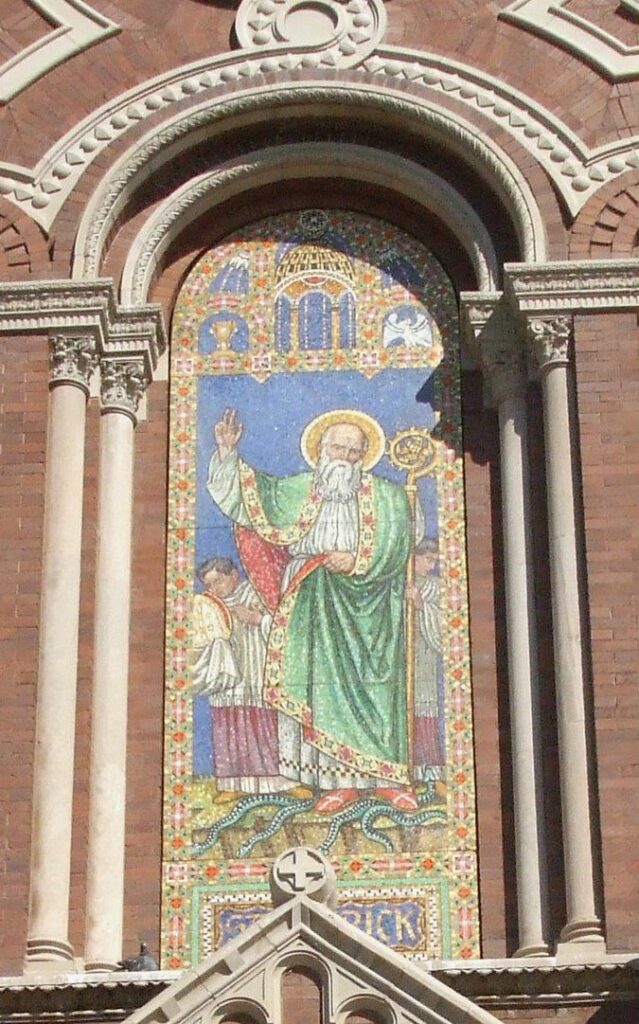
In some portrayals, the saint is shown with snakes in addition to, or instead of shamrocks, as in the photo above. This is due to the legend of him driving all of the snakes from Ireland. However, today most understand the term ‘snakes’ to be a pejorative for Druids, Picts or Anglo-Saxons, as they worshiped many different deities, and snakes are not indigenous to Ireland.
But how did he become the patron saint of Ireland and why do we still celebrate him today? Saint Patrick is credited with bringing Christianity to Ireland and at least partially responsible for the Christianization of the Picts and Anglo-Saxons. But his support and defense of the Irish against mistreatment by the British is most likely the primary reason why he is not only Ireland’s patron saint, but is considered by many to be associated specifically with Catholic Ireland and synonymous with Irish national identity. Subsequently, Saint Patrick is a religious and patriotic symbol along with the color green and the shamrock. Traditionally, Irishmen have worn shamrocks, the national flower of Ireland, in their lapels and raised a glass in toast to him on the Feast of Saint Patrick, March 17th. Slàinte Mtath!
Header Photo: Andreas F. Borchert, CC BY-SA 3.0 DE

Saint Patrick banishing snakes Photo: Lyricmac at English Wikipedia

Biography: Brittania