
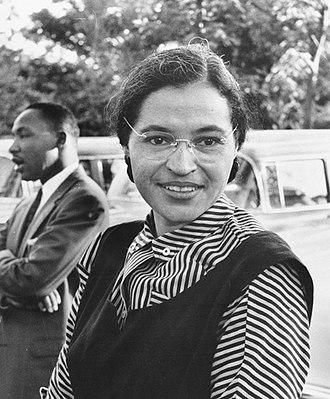
‘You may do that.’
R.P. said after the bus driver told her that he would “call the police” if she did not vacate her seat for a white person.
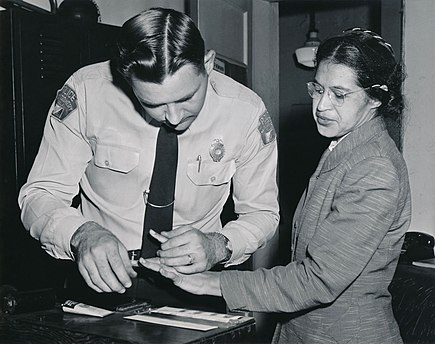
Rosa Parks being fingerprinted by Deputy Sheriff D.H. Lackey after her arrest for boycotting public transportation.
It is the first week of Black History Month and today would have been Rosa Parks 108th birthday. She was arguably the catalyst of the bus boycott and considered the mother of the movement. Mrs. Parks was a tireless social justice and civil rights activist. She worked as a seamstress and put her spare time to good use by working as a secretary for the Montgomery chapter of the NAACP. She stayed engaged in civil rights and later in politics. She helped get elected and worked for U.S. Democratic Representative John Conyers from 1965 until she retired in 1988.
One wonders what she would think of the current state of affairs here in the United States of America. In this land where the majority of bus drivers are still white while the riders are predominately people of color. A place where one may take any empty seat, but many bus routes are truncated in urban and rural areas limiting access to those who need it the most.
And would she find it odd that a person of color may take any empty seat or even be allowed to drive the bus, but is afraid to board it due to systemic racism that renders them more vulnerable to coronavirus exposure. Those that ride public transit to work or drive, as their work are typically categorized in the group we call essential workers who don’t have the luxury of staying home and being safe.
One further wonders when the histories of individual ethnic groups will be completely integrated into a collective history, fully fleshed out and accurately told. Mrs. Rosa Parks would probably agree that we have many more miles to go before we reach our destination of equality for all.
We celebrate her courage, dignity, strength and unwavering stance against racism and injustice.
Awards: NAACP’s 1979 Springarn Medal, Presidential Medal of Freedom, Congressional Gold Medal
Interesting Facts: The first female to lie in honor in the U.S. Capitol Rotunda. There is a statue of her in the U.S. Capitol’s National Statuary Hall. There are United States’ holidays in her honor. In California and Missouri Rosa Parks Day is celebrated on her birthday, February 4th and in Ohio and Oregon on the day she was arrested, December 1st.
Twelve years before her history-making arrest, Parks was stopped from boarding a city bus by driver James F. Blake, who ordered her to board at the back door and then drove off without her. Parks vowed never again to ride a bus driven by Blake. As a member of the NAACP, Parks was an investigator assigned to cases of sexual assault. In 1945, she was sent to Abbeville, Alabama, to investigate the gang rape of Recy Taylor. The protest that arose around the Taylor case was the first instance of a nationwide civil rights protest, and it laid the groundwork for the Montgomery bus boycott.[23]
In 1955, Parks completed a course in “Race Relations” at the Highlander Folk School in Tennessee, where nonviolent civil disobedience had been discussed as a tactic. On December 1, 1955, Parks was sitting in the foremost row in which black people could sit (in the middle section). When a white man boarded the bus, the bus driver told everyone in her row to move back. At that moment, Parks realized that she was again on a bus driven by Blake. While all of the other black people in her row complied, Parks refused, and she was arrested[24] for failing to obey the driver’s seat assignments, as city ordinances did not explicitly mandate segregation but did give the bus driver authority to assign seats. Found guilty on December 5,[25] Parks was fined $10 plus a court cost of $4[26] (combined total equivalent to $134 in 2019), and she appealed
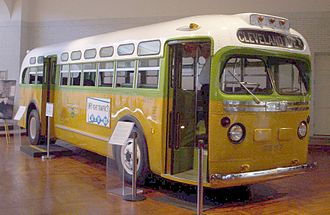
(a GM “old-look” transit bus, serial number 1132), is now on exhibit at the Henry Ford Museum.